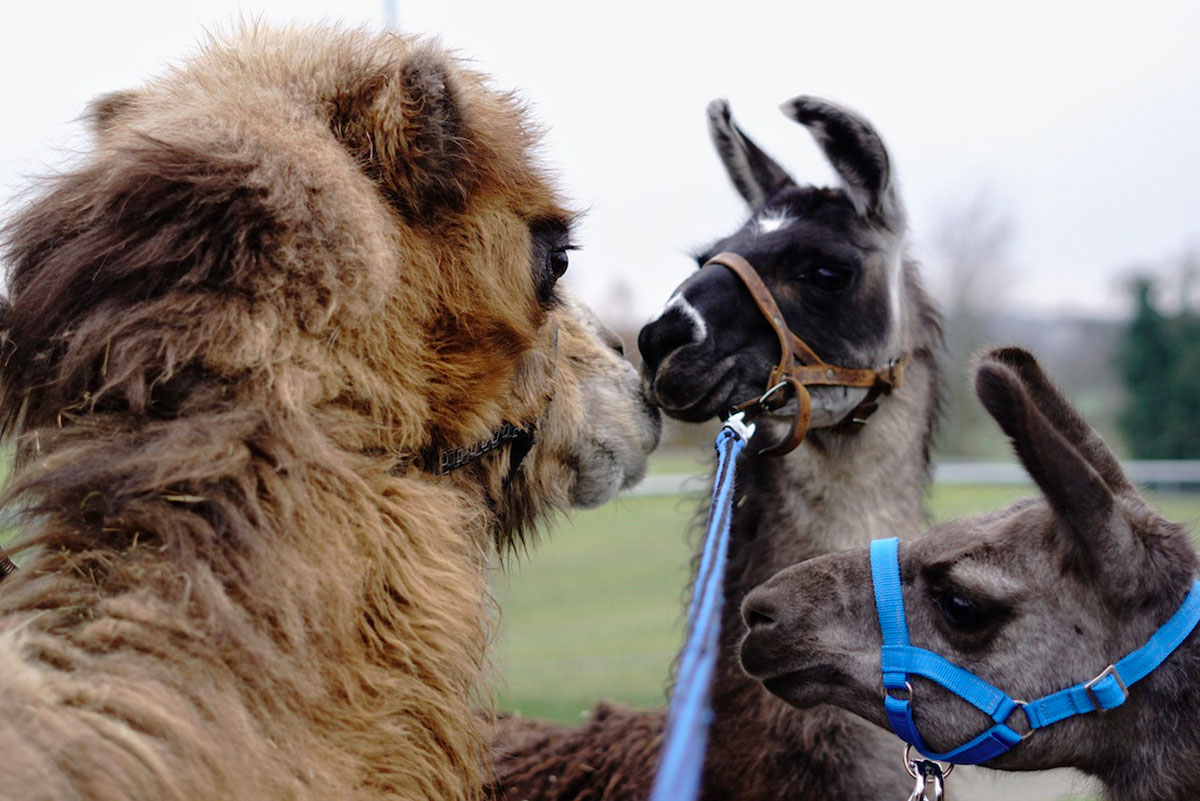
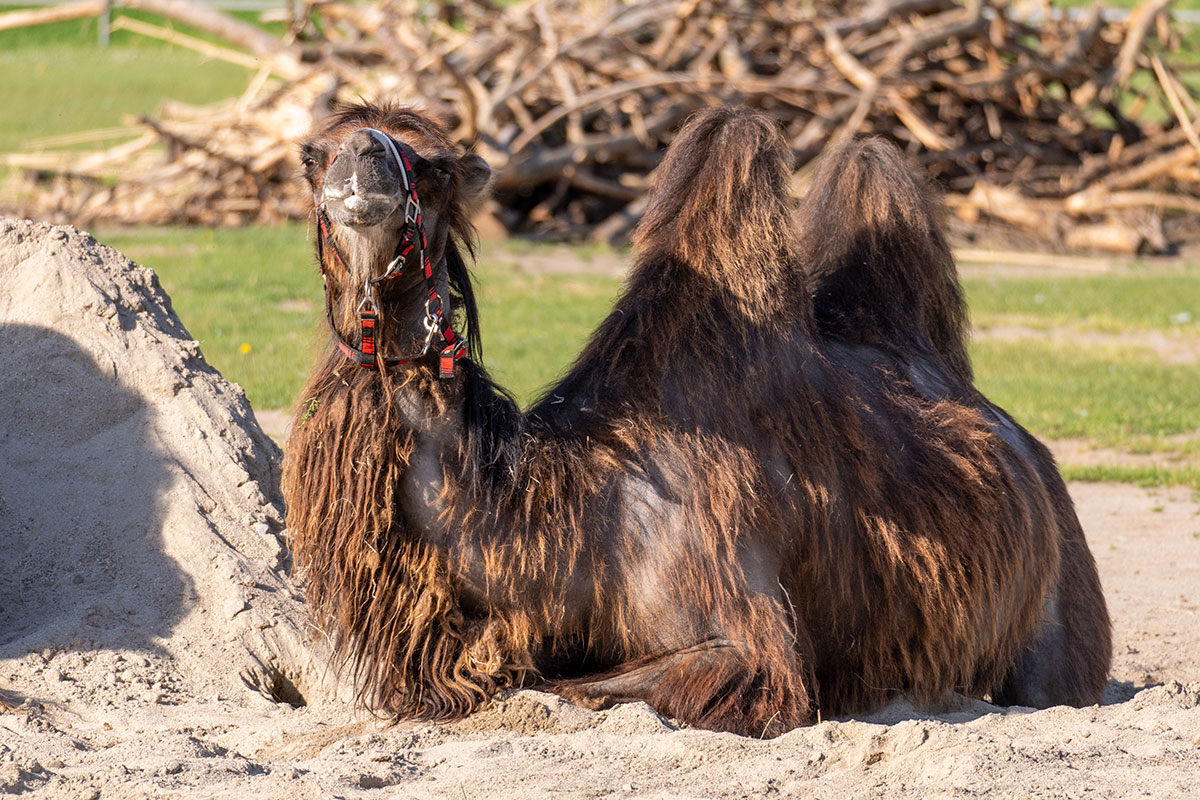
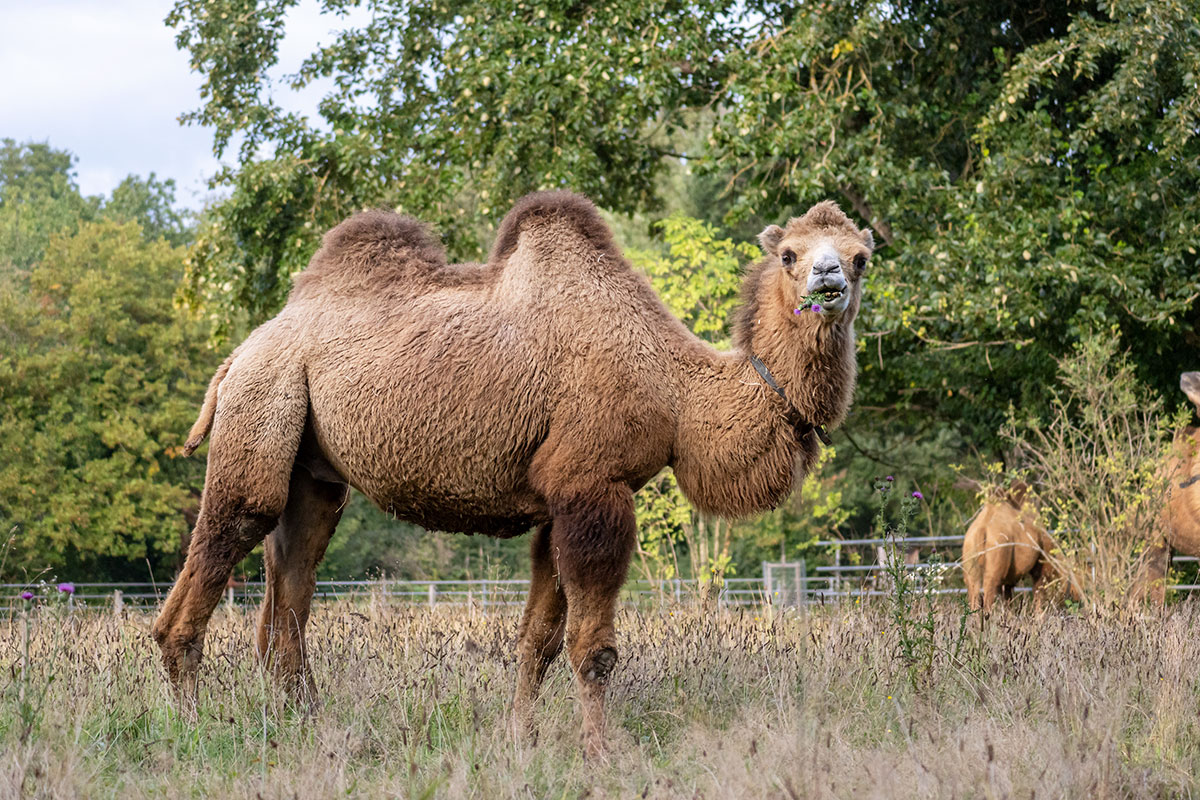
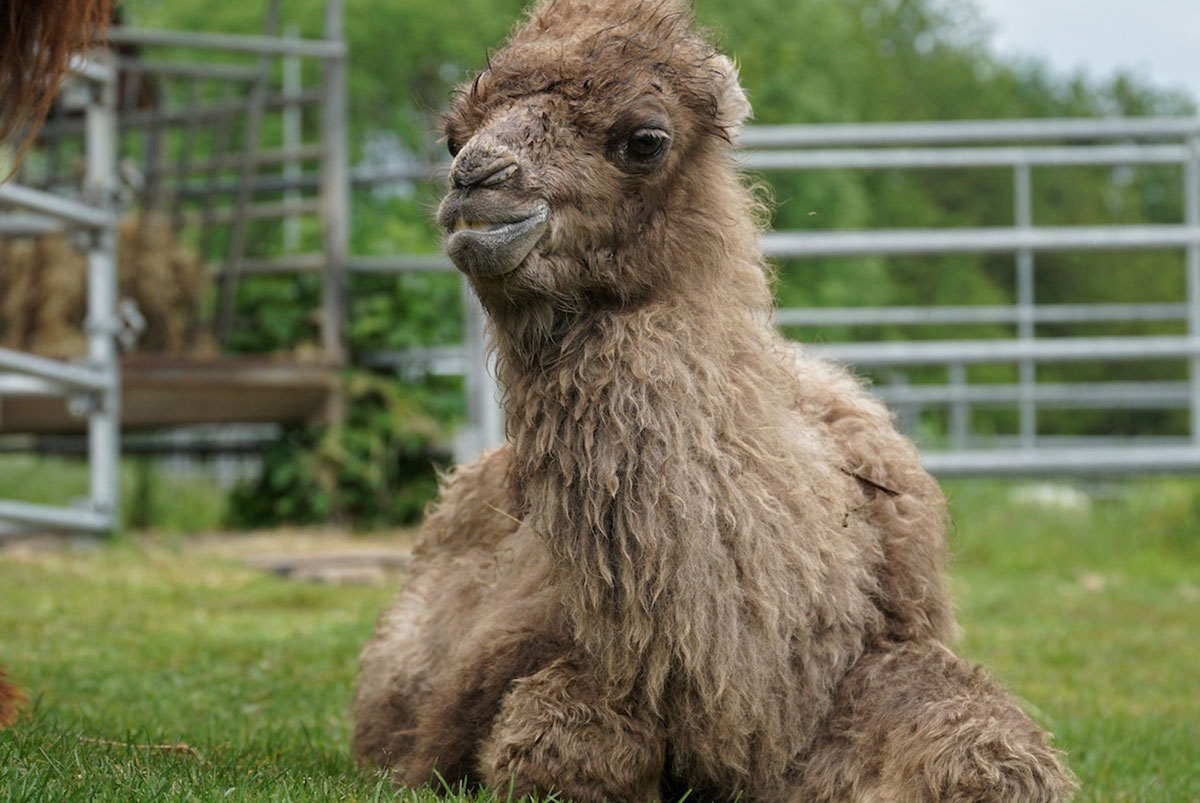
First things first: yes, the animals in this enclosure are camels! But we can be a little more specific. The word “camel” doesn’t just refer to a single species, but rather to an entire family within the order of even-toed ungulates (Artiodactyla). This family is made up of Old-World camels (genus Camelus) and New-World or South American camelids (genera Lama and Vicugna). As well as the species llama, these New-World genera include the alpaca as well as wild forms such as the guanaco and vicuña. But when people speak of camels, they usually mean the Old-World camels: the single-humped dromedary and the two-humped Bactrian camel. The animals living here in this paddock are Bactrian camels, also known as two-humped camels.
Camels are the sole surviving family of the suborder Tylopoda (“pad-footed animals”). They are named for the underside of their two toes, on which they walk, consisting of a supple pad of fibrous connective tissue.
The gender terms used for camels are like those used for cattle, with some horse-related terminology thrown in. Generally speaking, a male is a bull (or a gelding if castrated), a female is a cow, and a young animal is a calf. Dromedaries and Bactrian camels can interbreed; these hybrids are known as Tulus or Bukhts. They grow larger than either parent and have either a single elongated hump or two humps, one larger and one smaller.
Gregarious and undemanding
The Bactrian camel’s way of life
Bactrian camels are sociable animals that typically live in harem groups consisting of one bull and several cows alongside their young. Because there is room for far more females than males in these herds, mature bulls frequently live solitary lives.
The mating season for Bactrian camels falls between February and March. During this period, the bulls turn aggressive, battling fiercely for receptive cows and producing a foamy saliva that froths around their mouths. Mating takes place lying down. Twelve to 14 months later, the cow gives birth – usually to a single foal, rarely twins – weighing up to 70 kg. Just a few hours after the birth, the newborn is already capable of following its mother. The mother nurses her calf for around a year and a half, and Bactrian camels reach sexual maturity at three to four years of age. Their life expectancy is roughly 40 years.
Bactrian camels are undemanding herbivores that eat virtually anything available, whether tough, thorny, or bitter plants. This fibrous food enters a forestomach barely chewed and must be regurgitated for a second chewing before it can be fully digested. Although this process resembles rumination, camels are not classified as true ruminants because they lack an omasum (the third stomach compartment).
Master of adaptation from head to toe
Camel survival strategies
Camels are ideally adapted to life in deserts and steppes. It begins with their slit-like nostrils that can be closed at will to seal off the airways from dust during sandstorms. Large eyelids and a double row of long eyelashes shield their eyes from blown sand. To avoid sinking into desert terrain, camels have broad, wide pads on their feet that simultaneously insulate them from scorching ground. A tough, calloused pad on each knee provides extra heat protection when kneeling in hot sand.
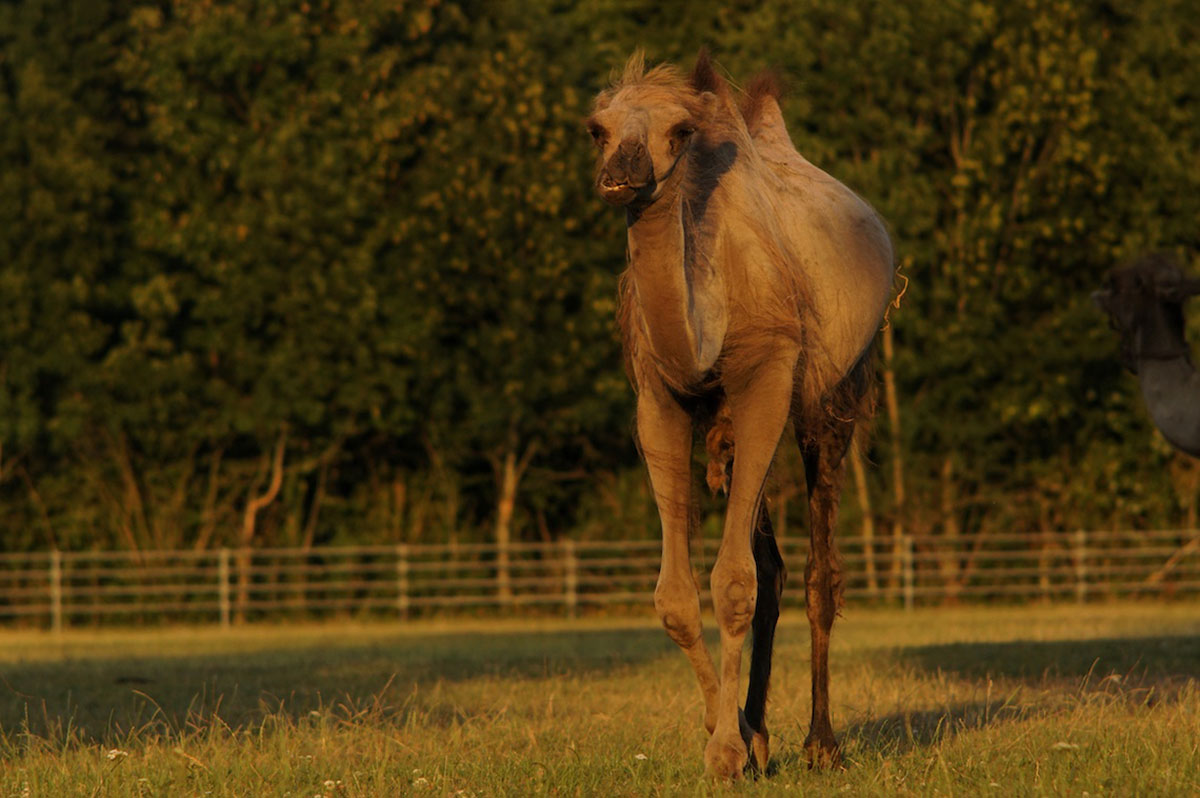
In winter, a thick coat protects them against bitter nights as cold as –40°C. To cope with summer temperatures soaring well above +40°C, they shed this winter coat rapidly in spring until they appear almost bare.
Camels also regulate their body temperature to endure these harsh extremes. Unlike most mammals, they do not keep their core temperature steady at around 37°C. When night falls cold, their temperature can dip as low as 34°C, conserving energy and allowing them to start the baking day pleasantly chilled. During the heat of the day, their temperature may rise as high as 42°C before they even begin to sweat and cool off. The great benefit: they sweat far less overall, saving vital water reserves.
Camels and water
Camels are renowned for going vast stretches without drinking – and deservedly so. But to dispel an enduring myth straight away: their humps are not filled with water! Instead, camels can tolerate losing up to 40% of their body weight in fluids. By comparison, humans face acute danger at a mere 10% loss, as our blood thickens to lethal levels. A camel’s circulatory system remains intact because it draws water not just from the bloodstream, but from body tissue as a whole. Specialised stomach cells and oval red blood cells enable the camel to store copious fluid for later use. Once a dry spell is broken, hydration is restored rapidly: a camel can drink 100 to 150 litres in a single session.
No water in the humps
If the humps are not water tanks, what are they? The answer: they are fat stores. When food is plentiful, camels build up reserves until their humps stand tall and plump. After a drought, when these reserves are depleted, the humps deflate and flop over to one side. Floppy humps can also be caused by genetic factors or age-related weakening of the connective tissue.
The humps are an integral part of their desert survival strategy: camels would quickly overheat if their fat were distributed across their entire body, as in most animals. Concentrated on top, the humps instead shield the body against too much overhead sunshine.
Lolloping gait – steady companions
Domestication and utility of camels
Domestication of the wild camel began more than 5,500 years ago; ever since, camels have served as beasts of burden and riding animals across arid regions. Humans have used and continue to use their meat, fat, leather, milk, wool, and bones, while dried camel dung makes valuable fuel.
Today, camels exist almost exclusively as domestic livestock. Fewer than 1,000 wild Bactrian camels remain in remote desert areas of China and Mongolia, making the wild species critically endangered.
Camels made their name primarily through arduous desert treks. Yet they earned the title “ship of the desert” not for their long voyages, but for their rolling, swaying gait: camels walk with a pacing stride, swinging both legs on one side forward simultaneously, creating a distinct pitch and roll.